“I’m so scared to run out of time.”
Me and George sit down and try to plan for our future
But there’s so much guilt involved when we stop working
‘Cause you’re not supposed to stop when things start working, no
[…]
I found love, baby
But I was scared to run out of time
[…]
So, we had a conversation on the way home, “Should I stop my birth control?
‘Cause my career still feels small
In the existential scheme of it all.”
— i think about it all the time ft. bon iver, by charli xcx
Part 1: Is time running out?
In a conversation with a stranger on a flight from NYC back to San Diego (where I was interning), we talked about the choices we consciously made in our work-life balance (aka: mostly the lack thereof). Among many things, he mentioned a consistent feeling that time was passing fast.
Of course, time passes fast. (…when you’re having fun? when you’re working on what you love…?)
But, I had just been talking to a friend in SF about feeling like “time is running out”, which I know is completely irrational, we’re twenty. And yet, here’s this stranger, somewhat older than me and disconnected from tech culture entirely, saying the same thing.
Is everyone beginning to feel this way?
There was this period in SF during my gap when I kept ending up in conversations where I’d explain what I was working on and feel myself shrink. Not because what I was doing was bad — it wasn’t, whatever ‘bad’ means — but because of how the words landed. People around me seemed to be doing so much — creating these beautiful systems, doing impactful research, raising rounds, “saving the world.” How can these words compare?
One thing that really got to me was my friends talking about “non-technical people” with an edge in their voices. Not about me, usually. But often enough that I’d think about it later and wonder at how respect is gained. And at events, guys who I thought wanted to ‘talk shop’ with me would pivot to something else — suddenly I was someone to date, someone to only talk about feelings with, not someone to go deep on the work with.
At the end of the day, I realize I’m a very adaptable person.[1] In the months I spent in San Diego after leaving SF, I found my groove — getting my drivers license (finally!!) and driving around at night blasting the music I love, working on pretty interesting problems with awesome coworkers, learning new things on my own time, having friends visit often enough I’m not bored, and occasionally going to live music (not just local: Fillmore Jazz Fest or flying to new jersey for Bleachers :D)… is this not what it’s all about? Yes, I’ve always hated being alone, but, in hindsight, a lot of that came from FOMO. In San Diego, I realized I was choosing to be alone, to do whatever I wanted. It felt great :).
The other interns and coworkers in SD/Apple also just cared about completely different things. Conversations were about what to do for fun. How to reach out to each other. They respected each other because of how each other showed up, not because of what they’d built or whatever they worked on. It was really nice to reinvent myself as well: one of my coworkers even told me, “You seem like a very offline person,” and holy shit. That might have never been said to me, ever, in the history of my existence.
My calendar this summer was also the emptiest it had ever been. I stopped scheduling everything, taking meetings, and pre-planning days. Instead, I gave myself long stretches of time to work on the problem I was trying to solve at Apple, or open times after work when I could spontaneously decide what to do. (Too often at MIT, I’d have to say no to something just because of the very delicate plans I’d made beforehand to ‘work on/study xyz’ and couldn’t stray.)
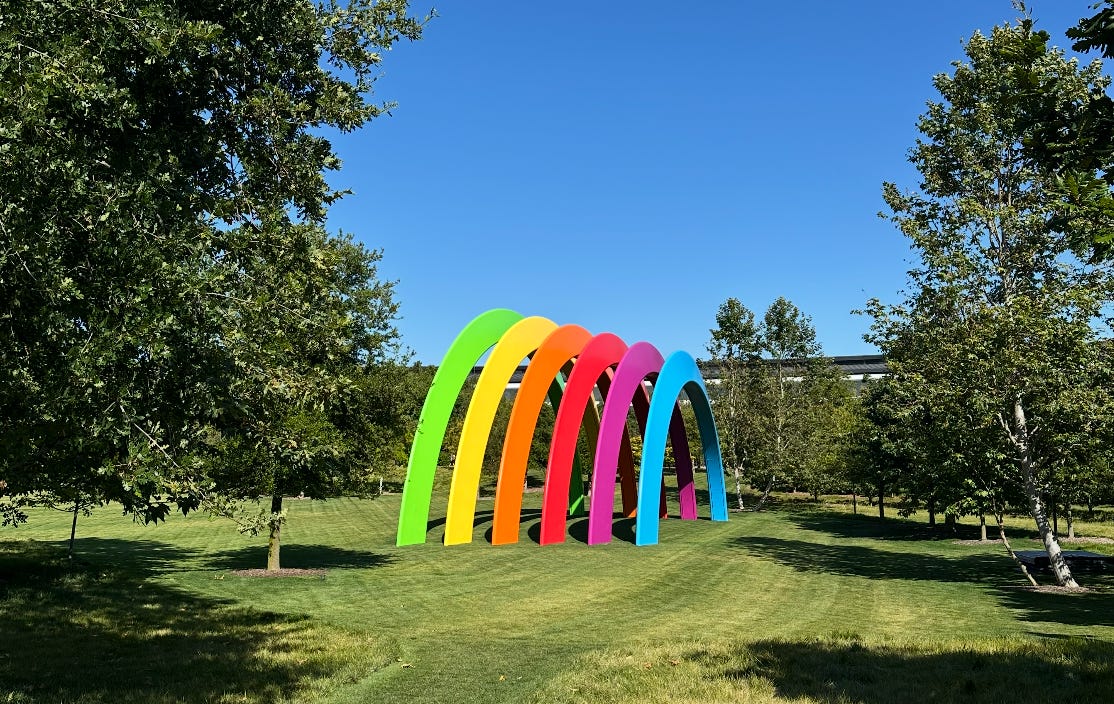
photo I took at apple park
Bleachers has a song called Ordinary Heaven that I think about often.[2] He has this repeating line of “I long for ordinary heaven / just to be your witness / … / You dance around the apartment / … / and I just, I just get to be there”
And, in an interview with Coup de Main, Jack (lead singer of Bleachers) says:
“It’s amazing how you can experience the heaviest thing in the world, like wanting to be with someone forever, yet how light it can make you feel”
— Interview: Bleachers - how to leave your hometown and survive.
This really spoke to me! For the longest time, I just didn’t believe in this, that you can find all the joy in the world just to watch someone dance, be happy… to feel the whole weight of emotions and ambition for something that is so illegible for anyone else. I think Jack realizes this too, that it clashes so directly with the idea of going on forever, when he quotes Tony Hawk’s movie / Rodney Mullen’s monologue at the end of that song Ordinary Heaven:
I’m not numb to the pain
I would argue I’m more conscious of it than anybody else
But I’m also more conscious of what that gives me
And when I’m done with this
That will be what it is, and I’ll find a way
But there’s something inside of me compelling
That I’m not going to give up
Until the wheels fall off
That’s what I’m made of
[…]
Ultimately, we also know what we have
To go lay down in the sense of it
That’s like, embracing what we’ve done with our lives
You gotta keep going until the wheels fall off!! But then… ultimately… we gotta lay down in the sense of it, embracing what we’ve done with our lives.
I kept treating these two like opposites, as if ambition and ordinary heaven were directly opposed to each other.
But what if they’re not? What if the “wheels fall off” thing IS about protecting the ability to witness someone dance around an apartment?
Recently, I caught up with Alex, and he told me he realized that being around people he loved was the most important thing to him (as far as he knows), so he’s quitting his job to do something more creative and aligned with that. He isn’t someone who normally takes big risks, he told me. But maybe these things don’t feel like big risks when you figure out your values. It feels obvious. He tells me he sees the musicians around him at Berklee move to Nashville or LA with just $40 to their name, yet there is no other life they were willing to live. How can he, with savings and a software engineer’s salary, not do the same?[3]
Rodney isn’t just talking about skateboarding. He’s saying: I push this hard because when I’m done, I want to be able to lie down and embrace what I’ve built. The intensity protects the gentleness.
Ordinary heaven is completely illegible to external observers. No one can measure how much you loved someone. Yet, it is the only thing you can optimize for, and I think we’ve spent too long thinking that it’s impossible to achieve.
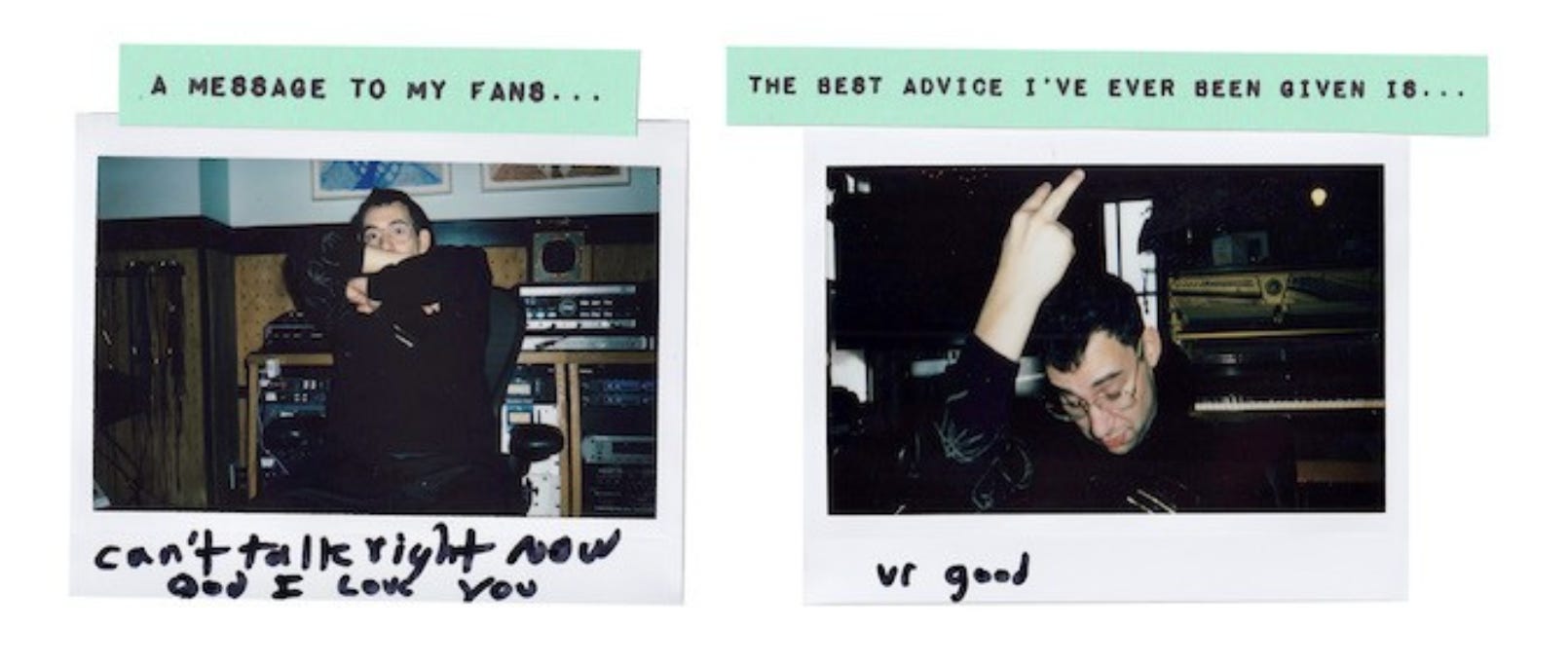
'ur good'
There’s a concept Kai introduced me to called the Ulysses pact:
The Ulysses Pact, also known as a commitment device, is a strategy inspired by the Greek hero Ulysses’s clever plan to resist the Sirens’ alluring song. In essence, it’s a way to pre-commit to a future action, even when faced with temptation or when your future self might be less rational or motivated. It involves setting up constraints or incentives in the present to influence your future behavior.[4]
I’m scared of the future version of myself.[5] Who should I trust? The version of me right now that thinks I need to spend most of my life prioritizing learning things, work, contributions to the fields I care about… or the potential version of myself in the future that has figured out what it’s all about?
Honestly, I’ve already kind of reached that now. Before my gap semester, I knew there was a very real risk that I wouldn’t want to return to MIT and didn’t know how to ensure I would. Because, understandably so, I spent a lot of time in those months thinking about the work I really enjoyed and the happiness I felt being around friends + meeting so many people/orgs doing cool things, and wanted to stay there! How do I know who is making the “right”, informed choice? Me, now, who has been enamored by the magic of working on one thing, or the me 6 months ago who knew that I needed to learn more?
It’s probably impossible to ever make fully… rational decisions that are not colored by the current mental state. (My solution so far has been to write down the entire mental state you’re in when you truly believe something and go back to it at moments of big decisions.)
When I tell older people about these feelings, they write it off as youth. They’ve told me that, at some point, your priorities will just click and change, and you’ll wake up. I don’t quite buy it. Who gets to make decisions about your future? Twenty-year-old you or forty-year-old you?
The feeling of time running out is like a latent, constant panic, a slow, degenerating crash out.
It’s also from a fear of being left behind by my peers. My mom used to always tell me that people will respect you and care about you insofar as you are someone worthy of that to them — and while I’ve now learned this is never fully that true, it’s stuck with me more than I’d like to admit.
Especially as I meet more and more cool people, the more this feeling resurfaces, where the things I had previously thought were good and interesting for me feel… suddenly, not enough? In some ways, I am still too easily influenced by the optimizations made by the people around me.[6]
This ‘panic’ is not easy to resolve, and I have by no means fixed it. But, as Bleachers will always remind me, when all we can do in life is small local steps, I’m going to try to find my ordinary heaven.
But I am home wherever you are near
There’s no life in anything when you’re not here
What could take my love away?
Maybe I was destined for philosophy
Leading leftist ideologies at the Paris-Sorbonne
Dreaming up the splendid demise
Of the societies we despise, at Café de Flore
But these things lose all their meaning and allure
If you’re not there to witness the grandeur— love in the time of socialism, yellow house (one of the best songs in the world)
Part 2: Actual Reflections from the Gap
This is my attempt to write a postmortem for my gap semester, which was from January 1, 2025, to August 28, 2025 (theoretically including the summer), recouped based on a series of texts I sent to my friend Sandra. It is a list of some reasons I initially had for the gap, and my 8-month-later retroactive.
1.
I wanted to see if neurotech / the overall field was the field I actually enjoyed working in. Somewhat like a/b testing of whether the working experience was interesting! There are a few reasons this was top of mind. I was (am?) somewhat worried that I enjoyed it purely just because I knew the most about it, “momentum,” and wasn’t giving myself a chance to explore a bit more. Also, the field of neuroscience is hard to work in: the research is often difficult to generalize (i.e., mouse studies ≠ human impact!), academia in life sciences is unbelievably slow, and a lot of neurotech can be somewhat grifty/fake.
6 months later: I realize I do love neurotech. Through the months in SF, I met so many people in the field and have a much stronger understanding of the players and problems in the field. It’s cool to have a real technical understanding of things and to see how much more I have to learn. I’ve also realized I have preferences in subfields. There are many open problems and many ways people are solving them (both right and wrong), and it’s opened my mind to all those possibilities. I still want to work on BCIs and truly change how people interact with reality.
2.
Being at e11 was a chance to work at an FRO, a real-world application of mechanism design that I wouldn’t normally get to walk into and see in action. From meeting people at Works in Progress and learning about alternative ways of conducting scientific research, I really wanted to see whether this format was too good to be true. If we can pursue a subset of ambitious science in FRO format, we’d be able to make strides in so many fields! Especially as scientific funding is so up in the air right now, this could be a nice way to not cripple the field of science (especially in the US).
6 months later: It really was very cool:). I am so very grateful to have had the chance to work with these amazing scientists, to have been able to contribute in any way I could (i.e., we just had a publication!), and it’s awesome to see that this sort of mechanism design works really well. My coworkers at e11 were the top of their respective fields, and I loved sitting in on the many passionate scientific ‘arguments.’
I’m so much more excited about these alternate ways of doing science. During my gap, I also spent some time helping Works in Progress, writing and branding for Age1 VC, and meeting the people behind Arc Institute and FutureHouse. I think we can really change how academia works and how scientists think![7]
3.
I was quite tired of MIT and kinda (read: really) burnt out. I had been feeling a bit isolated and had been thinking about gapping for a while. I love MIT, but I don’t think I relate as strongly to the sentiment that the college years are the years where you can just have fun, ignore consequences,… “the last best years of your life.” If this is indicative of the rest of my life, well. I really do not want to submit to a life like this. I think as time moves on, more and more people become less dependent on others — what I mean by this is that they’re no longer talking through life with others, no longer trying to find companionship everywhere. Instead, they make big life decisions and move through life without that hunger for people… everything becomes a “catch-up” vs. making memories together. And this also comes from people being way too busy (both specifically at MIT but also in general), where you either have to make timed plans with people to get food, OR you have one default group of people. This is perhaps why MIT culture is so surrounded by the dorms, since they’re probably the only people you consistently see (I’ve had friends I see once a month, purely just because we’re always too busy to hang out). I’ve written about this loneliness before, and I think a lot of it was my own fault: I overcommit myself to an unbelievable degree, and my social needs are to be around people almost all the time… and so these 2 facts are inherently contradictory.
6 months later: The gap gave me a Lot of perspective. Because of it, I’m going to do life and/or college very differently. (Well, I know I have to, but actual execution is a whole other story.)
This is also why returning to MIT makes sense for me.
This is perhaps no longer a cold take, but dropping out is not in the cards right now: I often feel that people drop out as a way to avoid the fact that you have to do things you don’t like in college. The people who tell you “I would never work for someone else” are the same people who can’t handle group projects, who can’t be assed to do assignments, who never go to class… I think there’s an enamoring of being like that without acknowledging that the only reason why this would ever be a good thing is if the person is challenging themself in other ways.
In my time away, I realized what I had really grown to take for granted. I love the Boston people I’ve befriended. The weekly Beans attendees are some of the coolest people, not least because they choose to show up for three hours every week to tinker and chat.[8]
And, it reminds me of what my high school friend Semira told me when I was deciding between which colleges to commit to. She said I keep relying on changes in my environment to fix my internal issues. At the time, I was choosing universities to fix things about me: I saw going to MIT as a way to force me to go through a ‘training arc’ and come out more confident and sure of my future. This obviously didn’t work. Going to a new place wasn’t going to inherently change the way I did things or my lived experience.
And yeah, coming back, the issues I had didn’t magically change immediately (surprise, surprise). Instead, I’m doing things differently, consciously! I’ve chosen to live in a dorm with a much stronger dorm culture (East Campus) and am trying to be as involved in the community as possible. I’ve joined WMBR and started my own radio show.[9] Music is one of the great passions of my life, so it’s honestly surprising I haven’t joined before. I’m reaching out to people I truly love spending time with and planning more weekly rituals (in the same vein as my SF weekly dinners). This term, I’m taking How to Make (almost) Anything and forcing myself to put in long swaths of time into it with less hour-by-hour planning. If MIT is going to be my ‘training arc,’ I need to give it the chance to be that, and HTMA is teaching everything I wanted to learn at MIT.
Before my gap, I was spending way too much time on classes. A great thing SF taught me is that it’s low aura to be worrying about grades… (to some degree obviously), and so in that vein I’m choosing classes that teach me real things and put in effort to learn and not think about grades at all. This has actually given me so much more time to do research, which was one of the biggest things I missed during my gap. I realized that pure engineering wasn’t for me: I enjoy a blend of engineering and running experiments to figure out how to do things.
So, I’m trying these things. Maybe they’ll work. I know I keep making the same move — new place, reset button — but this time I’m at least aware of it.
4.
I wanted to earn some money to pay for college.
6 months later: This wasn’t quite resolved through working at a research non-profit (or even as an intern at Apple).
5.
I’ve always felt a bit insecure abt my abilities and thought contributing directly at a company (especially a small startup) would help that and also teach me a lot! (I realized my research taught me more than classes)
6 months later: Sadly, confidence doesn’t come from proof. Yes, having more experience is vital. But I do not feel more confident in my life path or my skills because of the work I did; I feel more confident because of the conscious changes I made in how I thought about myself and my abilities. Meeting very confident people in SF (for better or for worse) taught me a lot about how to do this. There’s a sort of person that, upon being faced with a difficult problem, won’t question if they’re the right one for the task but rather believes that, given time and effort, they can figure it out. In direct contrast, there are those who ruminate endlessly, wonder if they’re the right person, if they’re choosing to put time into the right thing… Perhaps, in the most fucking cliche conclusion possible, you kind of have to just do it.
Ultimately, I don’t regret this gap at all!
Turns out confidence doesn’t come from external proof of things — it comes from deciding you’ll figure it out given time. Meeting people in SF who just did things, rather than ruminating about whether they were the right person for the task, taught me more than any project milestone ever could.
I answered the questions I set out with: I love neurotech (and still want to work on BCIs and change how people interact with reality), FROs actually work and can change how we fund science, and research engineering is way more my thing than pure engineering. And I’ve been enacting the plan I came back with — East Campus for default proximity to people, weekly rituals instead of endless scheduled hangouts, my radio show, HTMAA, caring less about optimizing for grades.
Maybe in two years, I’ll write another one of these and realize I was doing the Semira thing again. But at least this time around, I know what actually works. :)
Context: From Jan-May, I was in SF working as an ML engineer at E11 bio, and from Jun-Aug, I was in San Diego as a CoreOS intern at Apple! ↩
Actually, this was one of my least favorite songs on the album for the longest time until the third time I heard it performed live… ↩
He writes about this a bit in his blog post I like me better when I’m with them. ↩
Here are some examples of commitment devices people have used:
- Money (automatic bill payments/investments), shoutout to Xi for being that for when I really needed to get some work done
- writing sales copy before creating the product (Len Markidan)
- James Clear (atomic habits guy!) had his assistant change social media passwords weekly (link) ↩From my friend John M:
“You are a servant to a powerful master whom you can speak to, but who cannot reply. Though she can’t communicate her desires to you, you use the scant clues you have to try to anticipate her needs and provide for them. You have an advantage in this, though: you yourself have such a servant, inferior and diminished to you though she is. She leaves gifts for you, or aids you with tasks — or at least she should. Sometimes she is lazy, or models your wants incorrectly, or is even outright malicious. This can be frustrating. But know that as you treat her, so too will your master treat you: ‘For in the same way you judge others, you will be judged, and with the measure you use, it will be measured to you.’” ↩In the same Coup de Main interview, Jack also has this quote:
On ‘Take The Sadness Out Of Saturday Night’, I was like: ‘Where do I go? What do I do?’ There was a song called ‘One More Step’ which didn’t make the album - I was just listening back to it because it came on shuffle - and it has this lyric: “I think everybody’s been right here / Can’t take a step, can’t turn back / I think everybody has been stuck right here.” The whole song was about trying to take one step and it’s such a sad song. ↩Over the past year, my professor, Ed Boyden, and my friend, Nina Khera, have been working on a blog/book about research thinking and academia, which you can find here: https://engineeringx.substack.com. ↩
I say this so often, but weekly rituals fix things. In SF, Devansh and I ran weekly Wednesday dinners that became the one chance for people in our circles to see each other consistently. We took turns cooking (so I learned to make real dishes!), and it felt like a hack to be able to have a day every week where people would come to where I was to hang out. In Boston, I run Friendly Beans with Alex, a weekly co-working session that has led to many friendships with people I would never have met: musicians, actors, activists, engineers… ↩
Please listen to my radio show, death car for qt! Listen at 88.1 FM WMBR in Boston or at wmbr.org on Monday nights (12-1 AM EST, 9-10 PM PST). I write up my tracklists and notes at clairebookworm.com/radio. ↩